31 for 21: H is for Heart

The stories of Hannah living with her heart defect and the surgery itself are better left for a day when I can give them the time they deserve.

Instead I’m sharing some of the moments that stand out the most from the surgery…

I refused to carry Hannah into the hospital in the car seat because I wanted to hold her for as long as I could.

During pre-op we had to change her out of her jammies and into a kid sized hospital shirt that was way too big for her. She’d never looked so small and innocent before, just staring intensely at her hand.

IMG_4503

A female anesthesiologist assistant was sent to us to take Hannah, as if handing my baby over to a woman would make it easier. Hannah was sound asleep when I gave her to this stranger.

IMG_4504

As we walked out of pre-op my only thought was “what if that’s the last time I see Hannah awake?” 

Watching Hannah wake up from sedation might be the worst moment of my life. She was silently screaming, her face filled with terror and panic as she fought against the arm restraints. The nurse called for help because the situation was becoming an emergency. It was like a scene from a television medical drama when doctors and nurses rush into the room.

Hannah wore a pink bow and booties every day.

IMG_4510

She smiled at every single person who looked at her. Even during 2 am chest PT and vitals.

After only 6 nights we got to take her home.

IMG_4613

31 for 21: G is for Grabbing

Pete and I are fully aware that Hannah won’t hit developmental milestones at the same time as her typical peers, and that when she does, the moments might be sweeter than they would for typical parents. I must be the world’s biggest sap because even the smallest signs of progress cue the waterworks.

Over the last few weeks Hannah has developed a huge desire to grab all.the.things. More specifically, grab them with both hands. This is a big step for her because she had a tendency to only use one hand at a time, and usually favored her left. My dad, Jeep to Hannah, also noticed a difference in motor skills between the two hands. If she was under an activity gym, the left hand would smash the toys and the right hand would try to grab them. (Our Birth to Three teacher, Maureen, said it’s common for motor skills to develop differently.)

I started to notice the grabbing when Hannah was in a seated position. As I’ve learned, this is because babies will feel more comfortable using their arms if their heads and torsos are secure. Anyway, in the car seat she’ll grab the blanket before I can even place it on her lap, or she reaches up to grab the plush fish dangling from the handle. When she’s in her rock n’ play, she goes absolutely nuts when she sees her cloth book Fuzzy Bee and Friends, crinkles the pages, whips the book around, munches on it. With both hands.

So far the best demonstration of her grabbing skills was in the bath the other night. What you don’t see in the video  is an extremely proud momma with tears in her eyes. A momma that loves to see the pure joy in her daughter’s eyes for a cup. A momma smiling so hard because her little one wants to grab something while holding on to another item. A momma that clearly needs to bring a box of tissues everywhere she goes.

Click here for video in case you missed the link above.

31 for 21: F is for Failure to Thrive

When Hannah was 8 weeks old we received another diagnosis. A diagnosis that I felt personally responsible for.

Failure to thrive.

A nutritionist, a complete stranger to us, looked at Hannah’s health as a series of numbers and decided that the numbers weren’t good enough. Her math showed that Hannah was only gaining a few grams of weight a day, instead of the 20-30 gram daily target. As the sole provider of Hannah’s nourishment I took this diagnosis to mean I was failing too.  

I cried in the nutritionist’s office. I was embarrassed, frustrated, and confused.

24 hours earlier the cardiologist told me that Hannah looked great, and though her weight gain wasn’t perfect, it was acceptable. She suggested meeting with the nutritionist to get a second opinion. It was an opinion I didn’t want. She was aware of the challenges Hannah’s diagnoses caused, but she didn’t experience them.

She didn’t understand I was trying my best. She didn’t understand I loved breastfeeding Hannah but sometimes she drank too much too quickly and would end up throwing it all up. She didn’t understand the harder I tried to wake Hannah up to eat, the harder Hannah fought to keep sleeping. She didn’t understand Hannah was sleeping through the night, and there was a small window in the wee hours of the morning when she’d sometimes accept a sleepy bottle. She didn’t understand I woke up every morning at 1 am to feed Hannah, even if she only took an ounce.

None of it seemed to be enough. She wanted me to do more, which consequently meant less breastfeeding. For a mother who felt she had no control over anything happening to her daughter, this was incredibly hard to hear.

Thankfully, the pediatrician and visiting nurses were on our team and able to calm me down. The nutritionist was looking at one aspect of Hannah’s health. In the big picture she was doing well because she was eating what she could, not losing weight, and maintaining small gains. Hannah was thriving in her own little way. 

Post surgery Hannah loves her bottles!

31 for 21: E is for Eyes

One of the very selfish fears I had after Hannah’s diagnosis was that she wouldn’t look anything like me or Pete, that the 47th chromosome would overpower the other 46.

Then I saw her blue eyes.

My whole family and most of Pete’s family have blue eyes, but Hannah’s eyes take the family genes to a new level.

Those little orbs are the brightest and bluest of all. For weeks I stared at them trying to figure out if she had Brushfield spots (small white spots around the iris that are common with Down syndrome) or if they just naturally twinkled. As long as they keep sparkling it doesn’t matter why.

Hannah is the light of my life, and that light shines through the windows to her soul. With those eyes she can speak a thousand words. Surprise. Delight. Exasperation. Exhaustion. Love. She’ll drown you with love in those pools of blue.

Hannah eyes


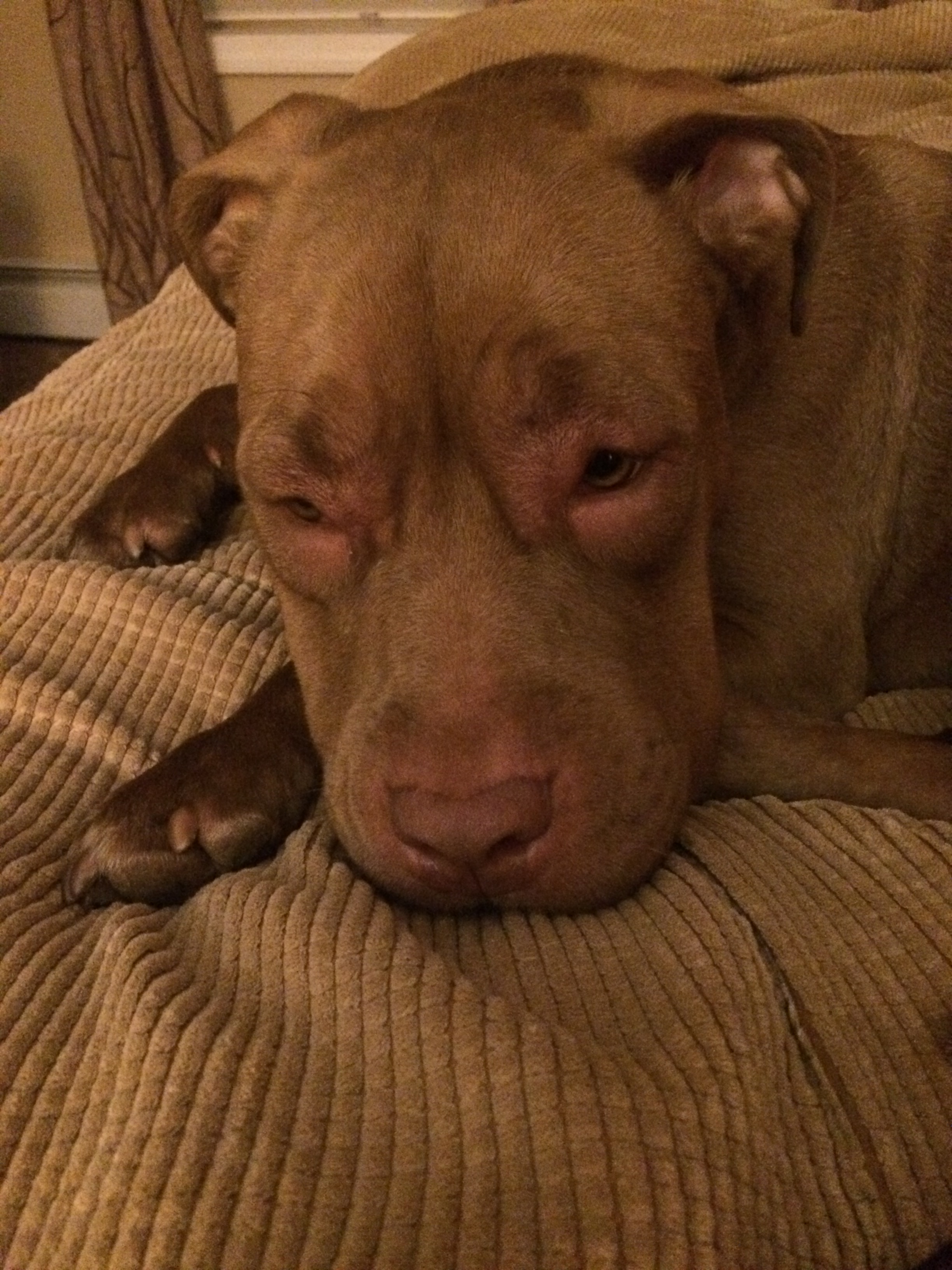
We had quite a busy morning yesterday. Hannah woke up around 3 am because she couldn’t breathe well through the lingering stuffiness from her cold. As I rocked her back to sleep, Gamy barged in the nursery and started scratching her face like crazy. The jingling of her collar woke Hannah up a little and I shooed Gamy back in our bedroom, where she kept scratching and jingling. Finally we turned on the light and saw the source of the itch. Her whole face was swollen – her eyes almost shut and jowls blown up like a balloon.

Pete had to drive 15 minutes to find a 24 hour CVS to buy Benadryl. It definitely helped but we set up a vet appointment anyway. The vet said it was most likely caused by a spider bite, gave Gamy a steroid shot, and sent us home with a few prednisone. Big thank you to Grandma and Grandpa for taking Gamy to the vet and watching her all day! The pup seems much better now, even though her eyes and nose are still red and her left jowl is saggy. Her energy level is back to normal and there has been no more scratching.

normal Gamy
Normal Gamy
balloon face Gamy
Balloon face Gamy

31 for 21: D is for Down Syndrome

Did you know there are three types of Down syndrome?  Trisomy 21 (nondisjunction), translocation and mosaicism.

TRISOMY 21 (NONDISJUNCTION)

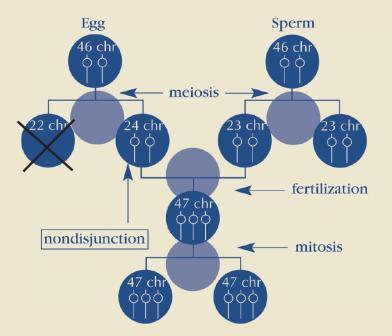
Down syndrome is usually caused by an error in cell division called “nondisjunction.”  Nondisjunction results in an embryo with three copies of chromosome 21 instead of the usual two.  Prior to or at conception, a pair of 21st chromosomes in either the sperm or the egg fails to separate.  As the embryo develops, the extra chromosome is replicated in every cell of the body.  This type of Down syndrome, which accounts for 95% of cases, is called trisomy 21.

TYPICAL CELL DIVISION

Typical Cell Division

TRISOMY 21 (NONDISJUNCTION) CELL DIVISION

Nondisjunction Cell Division

MOSAICISM

Mosaicism (or mosaic Down syndrome) is diagnosed when there is a mixture of two types of cells, some containing the usual 46 chromosomes and some containing 47.  Those cells with 47 chromosomes contain an extra chromosome 21.

Mosaicism is the least common form of Down syndrome and accounts for only about 1% of all cases of Down syndrome.  Research has indicated that individuals with mosaic Down syndrome may have fewer characteristics of Down syndrome than those with other types of Down syndrome.  However, broad generalizations are not possible due to the wide range of abilities people with Down syndrome possess.

MOSAIC CELL DIVISION

Mosaicism

TRANSLOCATION

In translocation, which accounts for about 4% of cases of Down syndrome, the total number of chromosomes in the cells remains 46; however, an additional full or partial copy of chromosome 21 attaches to another chromosome, usually chromosome 14. The presence of the extra full or partial chromosome 21 causes the characteristics of Down syndrome.

As usual, this information is from the NDSS website

31 for 21: C is for Community

Pete and I didn’t know anyone with Down syndrome so we were pretty lost after Hannah was born. The medical information we read was often overwhelming and told us what life could be like. We wanted to know what life was going to be like.

The more we searched the more we realized there is a huge virtual community of Down syndrome loving families. My Instagram feed is constantly updated with pictures and videos of beautiful, strong, and precocious children that just happen to have Down syndrome. 

Here’s a list of the families that add extra joy to my days. I would love some recommendations on other accounts and blogs to check out!

@downwithjax

www.downwithjax.com

@thatdadblog

www.wilcanfly.com

@lilcocobea

@mollieglasgow

@ahtharpe

@cjpics

@catfishwithketchup

www.confessionsofthechromosomallyenhanced.com

@lifewithhop

facebook.com/lifewithhop

@5boysand1girlmake6

@lstamour79

@lifewithmicah

@atourofhollandx2

@rfoxkipphut

@lexieloodylan2

@chasing_hazel

@itsabellazoey

@happysoulproject

www.happysoulproject.com

@atalialynix

31 for 21: B is for Buddy Walk

1995

  • The Buddy Walk® program was established in 1995 by the National Down Syndrome Society (NDSS) to promote acceptance and inclusion of people with Down syndrome and to celebrate Down Syndrome Awareness Month in October. The name Buddy Walk® promotes inclusion between friends of every ability.
  • 17 events took place across the country during the inaugural year of the Buddy Walk®.

1999

  • NDSS introduced the Times Square Video to bring attention to the Buddy Walk® program and raise awareness of individuals with Down syndrome in a public setting.

2001

  • NDSS introduced a new Buddy Walk® logo‚ the now familiar blue and yellow graphic of a family holding hands.
  • Over 100 Buddy Walk® events took place.

2002

  • Actor John C. McGinley joined NDSS as National Buddy Walk® Spokesman.
  • The Buddy Walk® site launched.

2003

  • More than 190 Buddy Walk® events took place in 49 states and 5 countries with over 180,000 participants raising more than $2.5 million.

2004

  • More than 210 Buddy Walk® events took place with over 200,000 participants raising more than $4.5 million.

2005

  • NDSS celebrated 10 years of the Buddy Walk®! From 1995 – 2005 over 1,500,000 people participated in Buddy Walks worldwide.
  • More than 250 Buddy Walk® events took place with over 200,000 participants raising more than $5.5 million.

2008

  • The Buddy Walk® public service announcement, starring TV Host Nancy O’Dell, TV Host Meredith Vieira, Actor John C. McGinley, Actor and NDSS Goodwill Ambassador Chris Burke, and Actress Andrea Friedman, was played nationwide at all Regal Cinemas before every movie for two weeks to celebrate Down Syndrome Awareness Month and the National Buddy Walk® program.
  • More than 250 Buddy Walk® events took place with over 250,000 participants raising more than $10.5 million.

2009

  • The first Buddy Walk® held on a military base in a combat zone took place at Camp Phoenix in Kabul, Afghanistan.

2011

  • More than 250 Buddy Walk® events took place with over 285,000 participants raising more than $11 million.
  • The first Buddy Walk® in Japan was held at Kadena Air Force Base in Okinawa

2012

  • More than 250 Buddy Walk® events took place with over 295,000 participants raising more than $11.75 million.
  • The Buddy Walk® has been ranked in the top 30 fundraising events nationwide for: money raised, number of participants and best series event since 2008 according to Run Walk Ride Fundraising Council Survey results.

2013

  • The Buddy Walk® had a record breaking year with more than 305,000 participants raising $12.1 million dollars in more than 250 events across the country and around the world.
  • Our first international  Buddy Walk® in Turkey took place in Istanbul, along with Walks in Tokyo, Japan; Auckland, New Zealand; Freeport, Bahamas; Port of Spain, Trinidad and Tobago as well as across Canada.

2014

  • The Buddy Walk® had another record breaking year with more than 315,000 participants raising nearly $13 million dollars in more than 250 events across the country and around the world.

2015

  • Our team, Hannah’s Heart, participated for the first time and raised $1150.

12042867_10102905327147991_8301063028561659724_n

Timelines taken from the NDSS website

31 for 21: A is for Advocate

ad·vo·cate

Noun

a person who publicly supports or recommends a particular cause or policy

synonyms: champion, proponent, spokesperson, campaigner, fighter, crusader


Advocate is one of the many words that has been added to our vocabulary since Hannah’s birth. Like any parents, Pete and I will always be our child’s biggest supporters. Advocating, however, is not just supporting your child – it’s fighting for them. You don’t back down. You’re a gladiator.

We already had to try our hand at this advocating thing when we insisted that Hannah’s heart surgery needed to be sooner than planned, and thankfully that fight was pretty easy. There will be more to fight for as Hannah grows up. We will be on the front lines in the battle for what’s best for her and she will be there right along with us. I hope to raise her with enough empowerment to advocate for herself one day.

6 Month Check Up with Hannah Banana

Tuesday afternoon the daycare called to let me know that Hannah’s cold was getting worse. She was fussy in the morning, wouldn’t tolerate lying flat, was having trouble with her bottles, and belly breathing. The director said it wasn’t an emergency, they just wanted to let me know. I called the pediatrician’s nurse line and left a message asking if Hannah needed to be seen. Like me, the nurse was concerned by the belly breathing and made us an appointment for 4:15.

I spent the next 2 hours doubting myself. Had I let the cold go too long without medical intervention? Did I miss a sign of something more serious? Was I wrong to shrug it off as a typical daycare kid’s cold? I know I only met her 6 ½ months ago but I think I know Hanah pretty well and she seemed OK to me. I was preparing myself to spend the night in the hospital with her connected to IVs and oxygen. Then Grandma texted – Hannah was fine. Seriously, have you ever seen a kid so miserable in your life?

happy Hannah

We kept the appointment to make sure there weren’t any issues. Lungs and ears clear. Oxygen levels at 100%. Can’t get much better than that! I asked a few questions about how to ease the cold symptoms and what would warrant an impromptu visit next time. She assured me that when post-surgery Hannah gets a cold it’s just like any other kid’s cold…except that Hannah’s nasal passages are smaller so she will sound worse, be sicker longer, and has a higher risk for ear infections than the typical kid. And that’s where I struggle. In certain aspects of her life, Hannah will be typical with an asterisk.


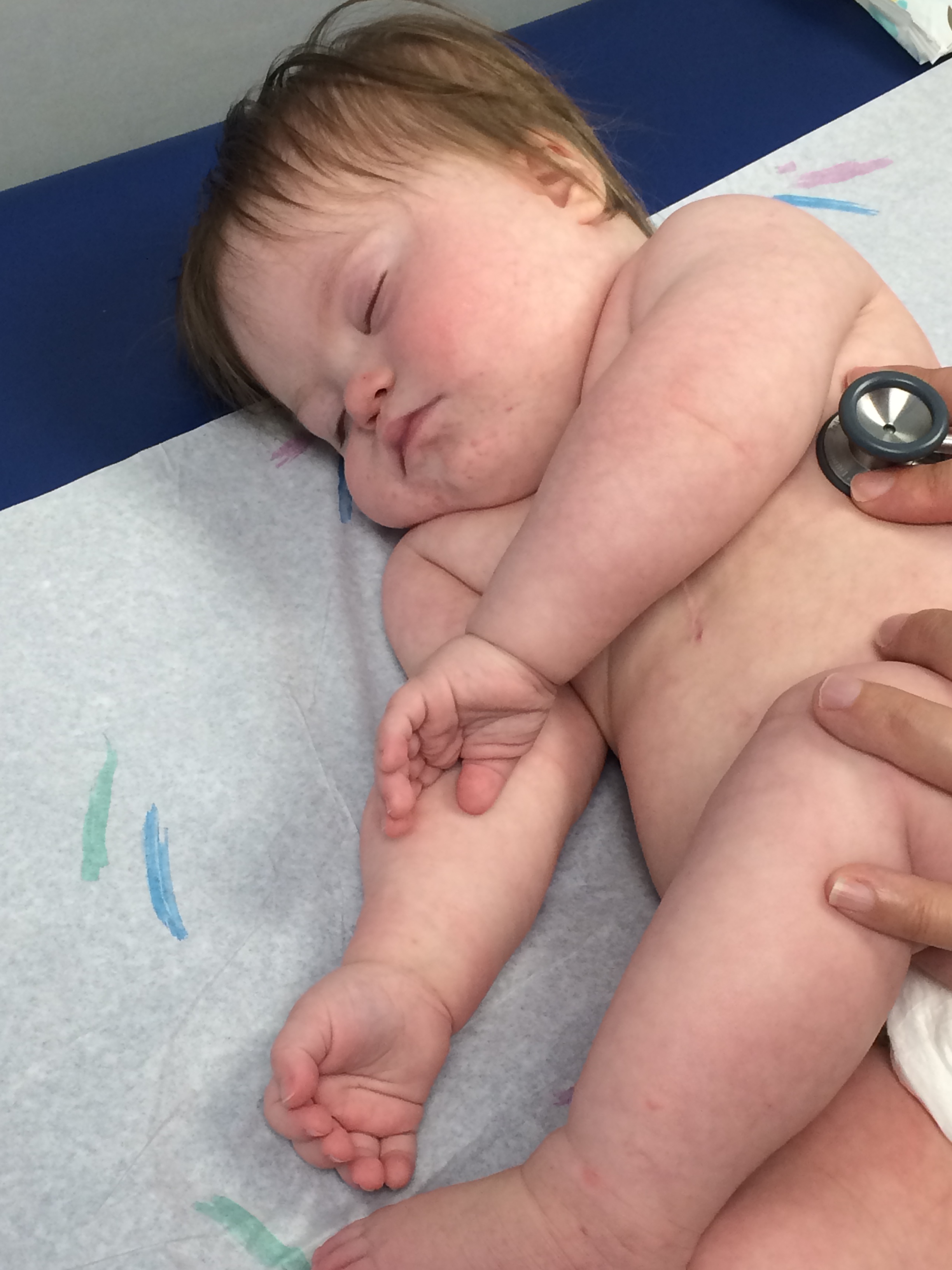
Yesterday afternoon we had Hannah’s late 6 month check up. Her weight is up to 6 lbs 14 oz and her length is somewhere between 26 and 27 inches (their measurements are not very accurate). I gave Banana a bottle while I asked the doctor questions about baby food, Hannah sleeping on her belly, and the flat spot on her head. Hannah fell asleep in my lap and managed to stay asleep for part of her exam. Homegirl must have been tired if she was able to ignore a cold stethoscope.
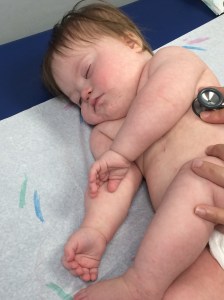
sleepy Hannah

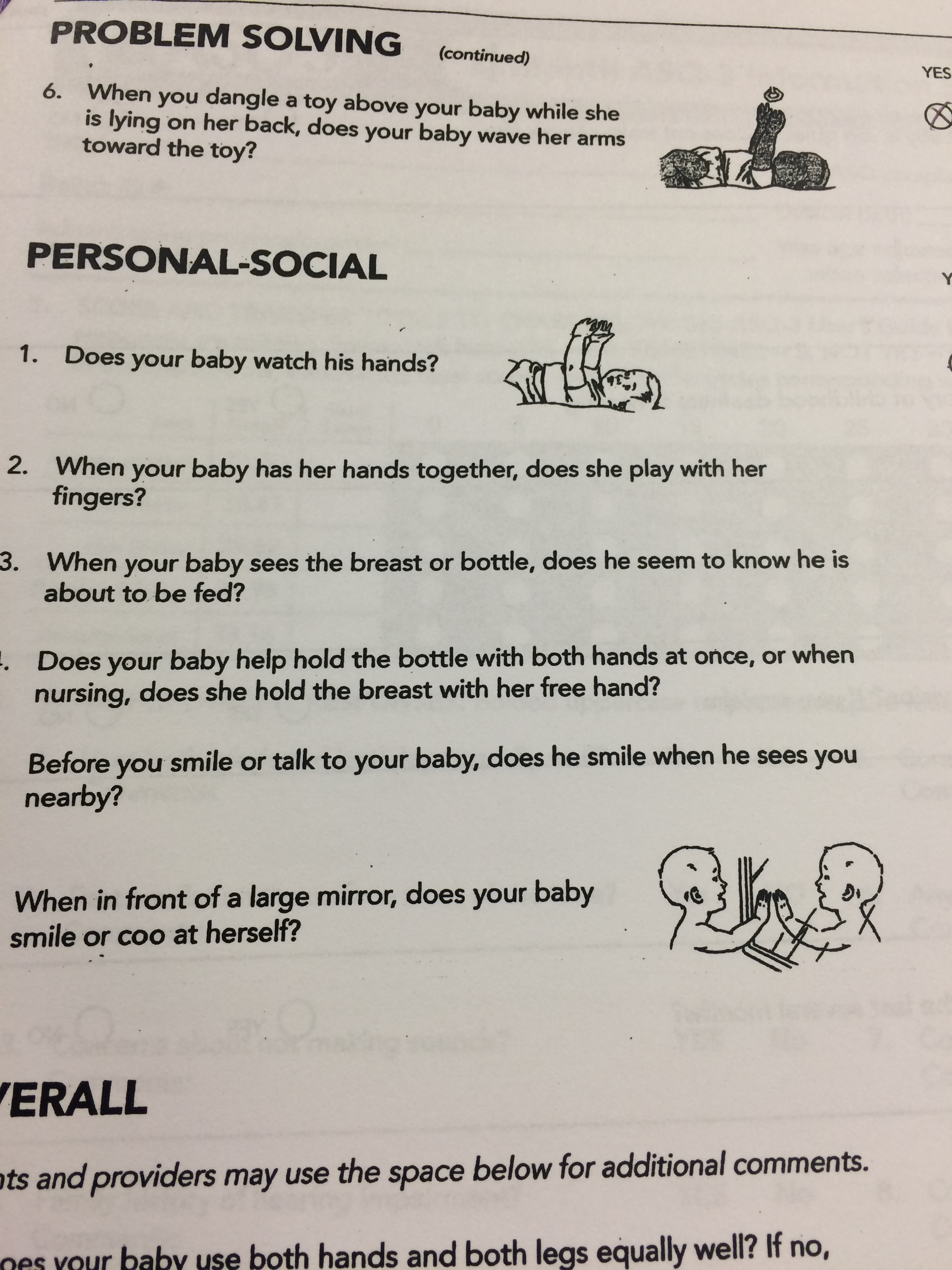
After the exam we talked about the questionnaire I completed in the waiting room. At the 4 month appointment, most of the questions were answered with ‘sometimes’ and ‘no’. This time around most of the answers were ‘yes’. Hannah has developed quite a few new skills in the last two months and I’ve even noticed a big change in her over the last two weeks. She’s so much more observant and wants to touch everything. I sat in the backseat with her coming home from the Buddy Walk and watched her look out the window, get surprised by the changing shadows and light on the backseat, and reach out for anything I dangled in her sight.  
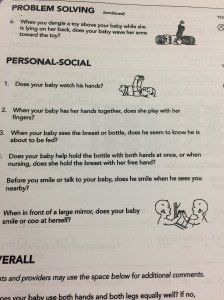
questionnaire

Once we got home we had about 45 minutes before our Birth to Three appointment so Hannah finished her bottle and took another nap. Maureen and I completed the Hawaii Early Learning Profile, which is pretty simple when evaluating a 7 month old. Hannah woke up fussy and in no mood to socialize or exercise. Instead of making her work, Maureen taught me some facial massages to do before feeding to help stimulate her muscles and I asked for tips on teaching her sign language.  When the visit ended Hannah took a long bath, had a small bottle, and it was a very easy bedtime.

Today could possibly be a rough day for the little one and the daycare teachers. She’s still a little stuffy and might be cranky from the vaccines she received yesterday. Fingers crossed for a happy day!